I Tried Five Different Book Formatting Tools To Find The Best One
Part Three Of The Self-Publish Your Book In 2026 Series
First, a Quick Reality Check About Book Formatting
Bad formatting is distracting.v
Weird margins, odd paragraph spacing, inconsistent fonts—these things pull readers out of the story immediately. They make a book feel rushed or unprofessional, even if the writing itself is good.
The goal of formatting is not to be fancy.
The goal is to be clean, readable, and invisible.
You’re formatting two very different things:
Print books (fixed layout, trim size, margins, headers, page numbers)
Ebooks (reflowable text that adapts to different devices and font sizes)
Some tools handle both well. Some don’t. And some are better suited to certain types of books than others.
The Main Book Formatting Tools Authors Use Today
Here are the tools I tested and regularly see authors using:
Kindle Create (free)
Atticus (paid, one-time)
Reedsy Book Editor (free + optional paid add-ons)
Vellum (paid, one-time, Mac only)
Google Docs (free, manual)
Bonus: Canva (for highly designed print books)
Let’s look at how they compare.
[Note, I do not have an affiliate link for any of these tools so none of these links are branded to me in any way].
Book Formatting Tools Comparison Table

Tool-by-Tool Breakdown (What They’re Really Like)
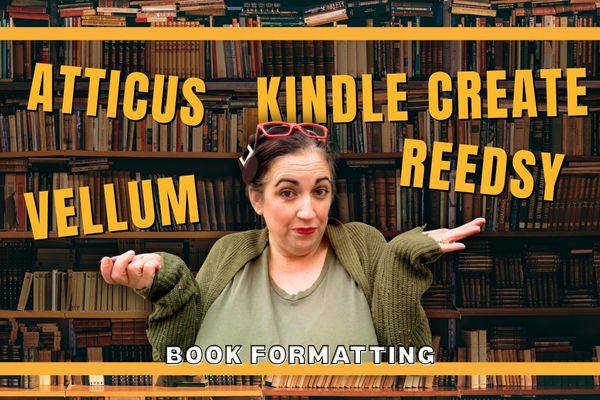
See behind the scenes of how to use each of these tools in this video:
Kindle Create (Free)
Kindle Create is Amazon’s own formatting tool. It’s designed primarily for ebooks, and it shows.
Where it works well:
Simple novels
Text-heavy nonfiction
Amazon-exclusive ebooks
Where it struggles:
Print books
Trim size control
Professional-looking interiors
The biggest issue is the lack of meaningful print preview. You often can’t see what your book will look like in print until very late in the process, which makes it frustrating and risky if you care about layout.
Verdict: Fine for basic ebooks. Not recommended for print.
Atticus (One-Time Purchase)
Atticus is the tool I’ve used for years—and for good reason.
It gives you real control without overwhelming you. You can preview your book on multiple devices, customize themes, control typography, and export both EPUB and print-ready PDFs.
What stands out:
Live preview for ebook and print
Reusable themes across books
Supports multiple trim sizes and distributors
No subscription
Downside:
It’s not great as a writing tool. There’s no built-in spell check, and Grammarly doesn’t work inside it, so I recommend drafting elsewhere and importing your manuscript.
Verdict: One of the best all-around options for serious self-publishers.
Reedsy Book Editor (Free)
Reedsy’s formatter is a great entry-level option.
It’s free, clean, and produces respectable results. It also includes a built-in spell check, which makes it more usable as a writing environment than Atticus.
Strengths:
Free
Clean, professional output
Built-in spell check
Nice front/back matter templates
Limitations:
Very limited customization
No true live preview
No alt text for images (accessibility issue)
Verdict: Excellent for first-time authors who want something simple and free.
Vellum (Mac Only, Paid)
Vellum is often used by hybrid publishers and nonfiction-heavy projects. It’s powerful and produces beautiful books.
Why people love it:
Polished, professional layouts
Strong live preview
Good for complex nonfiction
Excellent output quality
Why some skip it:
Mac only
Expensive
Verdict: Great if you’re on Mac and want high-end control. Particularly useful for publishing multi-author books or special editions with colored pages, edge designs, and other special touches.
Google Docs (Free, Manual)
Yes—you can format a book in Google Docs.
For ebooks, it actually works better than I expected. For print books, it requires a lot of manual setup and careful attention to margins, headers, and page breaks.
Pros:
Free
Total control
Easy EPUB export
Supports alt text
Cons:
Time-consuming
Easy to make formatting mistakes
Not beginner-friendly for print
Verdict: Viable if you’re very budget-conscious and detail-oriented.
Bonus: Canva (For Specialty Print Books)
Canva is not ideal for novels—but it’s fantastic for:
Workbooks
Planners
Illustrated editions
Special hardcovers
Public-domain projects
It gives you maximum design freedom, but everything is manual. You’re acting as the formatter.
Verdict: Perfect for design-heavy print books. Not recommended for standard fiction.
So… Which Book Formatting Tool Should You Use?
Here’s the simplest way to decide:
First book, zero budget: Google Docs
Publishing regularly: Atticus
Mac user, nonfiction-heavy: Vellum
Amazon-only ebook: Kindle Create or Google Docs
Highly designed print book: Canva
Unless I find out there's a way to put in ALT text in Reedsy, I can't recommend them.
Formatting doesn’t need to be scary or expensive. Your readers don’t need fancy.
They need clean, readable, and professional.
Once you get that right, the book gets out of the way—and the story does its job.
Watch me test out each one of them in the video here:
If you’re interested in self-publishing, I break down the real costs, systems, and steps so you can make informed decisions without overpaying or overworking in this blog and video series (follow along here or on YouTube).

Visit my shop to see author website templates and other book marketing resources! https://financiallyfreeauthor.com